
Shrink, Swap, or Innovate: Navigating the New Value Equation in Food
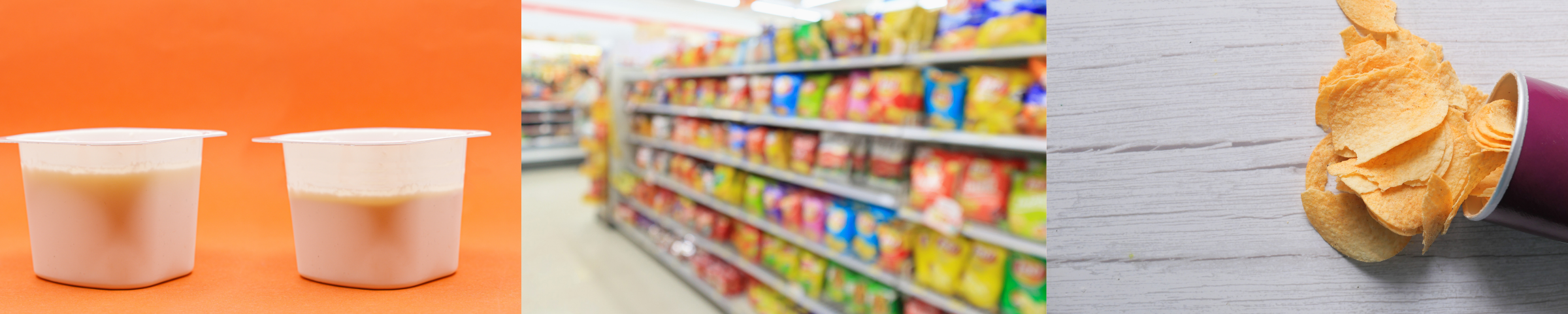
Something strange is happening on grocery store shelves. The bag of chips is lighter than it was two years ago. The yogurt cup is two ounces smaller. The frozen entree costs three dollars more and somehow feeds fewer people. Consumers have noticed, they're annoyed, and according to nearly every major retail data source tracking the market, they're making different choices as a result.
At the same time, super-premium food and beverage — the $14 olive oil, the small-batch hot sauce, the craft kombucha — is growing. The super-premium segment's dollar share rose from 72% to 76% between 2024 and 2025 per Circana, while mainstream and value segments both lost ground. Meanwhile, private-label store brands posted record sales of $282.8 billion in 2025, growing at nearly three times the rate of national brands, according to the Private Label Manufacturers Association.
These things are not contradictory. They're the portrait of a bifurcated consumer market under real economic pressure, and they carry specific and urgent implications for every brand, operator, and food developer trying to figure out what move to make next.
Understanding the Pressure
Consumer confidence has been soft. Circana's December 2025 Food and Beverage Outlook described the 2026 environment as 'tightening and more challenging,' with weak consumer confidence prompting shoppers — especially lower- and middle-income households — to pull back on discretionary spending and focus on price-value optimization. Inflation in food at home may have moderated from its post-pandemic peak, but the cumulative effect of several years of elevated prices has fundamentally altered how consumers think about what food is worth.
A decade of retail scanner data published in Marketing Science found that approximately 1.92% of products have been downsized in a given period — and that product downsizing is more than five times as prevalent as upsizing. Consumers pay more per unit volume without necessarily realizing it, because research consistently shows they're more responsive to price changes than to changes in package size. Brands have known this for years. Increasingly, so do consumers.
The result is a trust deficit. When shoppers feel they're paying more for less — whether through price increases, shrinkflation, or reformulation that quietly cuts ingredient quality — they don't just change products. They change brands. And in a category with as many options as packaged food and beverage, that switch is easy to make and hard to reverse.
Three Responses — and What They Signal
Shrink: The Short-Term Play
Shrinkflation — reducing product size while holding price — is the default response to margin pressure because it's operationally simple and consumers are demonstrably less price-sensitive to size changes than to price changes. The Campbell's Company partnered with Pabst Blue Ribbon on beer-flavored soups. Coca-Cola indicated it would shift to more plastic bottles in response to aluminum tariff pressure. These are not innovation stories — they're cost management stories dressed in minimal transparency.
The problem with shrinkflation as a sustained strategy is that it eventually gets noticed. News coverage has surged, Congressional legislation (the Shrinkflation Prevention Act of 2024) has been proposed, and the consumer relationship with brands perceived as pulling quiet tricks is increasingly fragile. Shrinking your way to margins is a short-term lever, not a long-term strategy.
Swap: The Reformulation Pivot
Swapping ingredients — substituting a premium input for a cheaper one, reformulating to hit a lower price point, or pivoting to a different format — is a more sophisticated response and can be executed well or badly. Executed well, a swap creates a genuine product improvement: a brand replaces an artificial dye with a natural colorant (Glimpse reports PepsiCo committed to eliminating artificial dyes from all U.S. food products by end of 2025), or reformulates a snack to add prebiotic fiber, shifting its positioning while lowering cost-to-serve.
Executed badly, swapping reads as degradation. The consumer who bought your product for its ingredient quality will notice when the ingredient list quietly changes. The brand that positioned itself around real butter and then switched to a butter-flavored oil has broken an implicit promise. The distinction between a value-enhancing reformulation and a cost-cutting one is often invisible on the label and obvious to the loyal customer on the first bite.
Innovate: The Harder Road That Wins
The most durable response to margin pressure and consumer skepticism is genuine innovation — building products that justify their price point through functional benefit, ingredient integrity, unique sensory experience, or some combination of all three. This is harder than shrinking and more complex than swapping, but the data strongly supports its long-term commercial advantage.
Circana's 2025 retail analysis found that super-premium products grew dollar share by four full percentage points in a single year, while mainstream products — the 'safe middle' of the market — lost share. The Food Institute's 2025 Specialty Shift report put it plainly: premiumization goes beyond price. It's about creating tangible product improvements, experiences, and emotional connections. Consumers are willing to pay more for products that solve a problem or enhance their lives — but only when brands communicate those benefits clearly and credibly.
The New Value Equation: What Consumers Are Actually Weighing
The concept of 'value' in food has been permanently complicated by the last several years of price volatility. It is no longer simply 'how much for how many ounces.' Modern value is a multi-variable calculation that includes ingredient quality and transparency, functional benefit, emotional resonance, convenience relative to occasion, and alignment with personal values (sustainability, health, ethics).
Circana's data shows that food and beverage spending is still growing at roughly 3% year over year, even as consumers pull back in discretionary categories. Food remains essential, and within that essential category, consumers are making qualitative distinctions. They will downgrade a mainstream snack brand in favor of a store-brand equivalent — but they will also upgrade to a $14 artisan hot sauce because the story, the ingredients, and the flavor experience justify the price. These are not the same consumer making the same decision. In many cases, they are the exact same consumer making different decisions in the same shopping cart.
The Food Institute describes this bifurcation well: consumers are focused on 'health and wellness 3.0,' which integrates premium ingredients, functional benefits, global flavors, and value as interconnected rather than competing priorities. The brands that understand this are not choosing between premium and accessible — they're building products that deliver premium value at a price point consumers can defend to themselves.
Private Label: Threat or Benchmark?
The record performance of store brands in 2025 is not simply a story about budget-conscious consumers trading down. Private-label growth is increasingly driven by genuine quality improvements. The PLMA notes that 'private label growth reflects a shift in consumer priorities, as retailer-owned brands increasingly compete — and win — on value, quality, health, and sustainability, not just price.' Retailers including Natural Grocers, Albertsons, and SpartanNash have launched private-label products in categories like cooking oils, herb blends, and flavored butters — territory that national brands once considered protected.
For national brands, the lesson here is not to panic, but to be honest about what differentiation they're actually delivering. A national brand that competes primarily on distribution and marketing spend is exposed. A national brand that competes on innovation, sensory experience, ingredient quality, and brand story has a real and durable advantage that private label rarely matches.

What Innovation Looks Like in Practice
The most instructive examples of successful innovation in a margin-pressured environment share a few characteristics. They identify a specific unmet consumer need — not a trend, but an actual friction point or desire. They build a product around that need with genuine ingredient and sensory craft. They communicate the value clearly, specifically, and credibly on pack and off. And they price to the value delivered, rather than to the competitive average.
Alternative sodas containing prebiotics and fiber are a clean example. The category holds a modest 6% of total beverage market share but is generating 27% of category growth, per NIQ data. These products are not cheap — they sit at a premium relative to conventional soda. But they solve a specific problem (consumers want a satisfying carbonated beverage that also does something useful for their gut) and they communicate that solution in plain, credible terms. That is the value equation in action.
Nestlé's launch of its first new brand in nearly 30 years — explicitly designed for consumers managing dietary changes, including those on GLP-1 medications — is another example of innovation responding to a structural consumer shift rather than fighting a commodity battle. General Mills and Danone repositioning high-protein and high-fiber products toward health-oriented consumers is a third. These are not shrinkflation stories. They are stories about companies looking honestly at who their consumer is becoming and building something that earns that consumer's business.
The Strategic Imperative for Operators
The value conversation in foodservice is structurally similar but plays out differently. Restaurant operators are navigating the same input cost pressures as CPG brands, compounded by labor costs and the consumer expectation that dining out should feel worth the premium over eating at home — an expectation that has gotten harder to meet as grocery prices have risen and dining prices have risen faster.
The operators winning in this environment are not simply the cheapest or simply the most luxurious. They are the ones offering what The Food Institute calls 'thoughtfully crafted menu items' — dishes with genuine culinary identity, premium ingredients used with purpose, and a dining experience that justifies the price through quality and storytelling. Bundled offers, in-store demos, and experiential elements that help guests feel they're getting more than they paid for are not sales gimmicks. They are intelligent responses to a consumer who is doing math every time they consider eating out.
The brands and operators that will win the next three to five years are not the ones who shrink their way to survival. They're the ones honest enough to ask whether their product genuinely delivers value — and innovative enough to build one that does.
Conclusion
The 'shrink, swap, or innovate' framework isn't a moral judgment — it's a strategic spectrum. Shrinking solves a short-term margin problem and creates a medium-term brand trust problem. Swapping can be executed brilliantly or disastrously, depending on whether it's driven by genuine improvement or quiet cost-cutting. Innovation is the hardest path and the most durable one.
The consumer market is telling food and beverage brands something clearly: they will pay for things that are worth it. They will not continue paying for things that used to be worth it. The job — as it always has been — is building products and experiences that earn their price. In a more transparent, more data-rich, more socially connected market than ever existed before, that job is both more challenging and more important than it's ever been.
Ready to Add Value?
Whether you're rethinking a product portfolio, trying to understand where your brand sits in the new value equation, or building something genuinely new for a consumer who has gotten smarter and harder to impress — Culinary Culture can help. Our team brings the trend intelligence, culinary craftsmanship, and product development expertise to help you build food and beverage that earns its place on the shelf and on the menu. Let's talk about what's next. Reach out to the Culinary Culture team today.